Research and Case Studies · Case Study 02
Ecocent
A study on leveraging the metal scrap recycling industry to manufacture coins instead of using virgin metals, reducing carbon footprint and production costs while keeping materials in the circular economy.
Design Question
How might we leverage the scrap recycling industry to produce a greener, environmentally and economically sustainable coin for the US economy?
Approach
Author
Dave Remedios
Type
Case Study · Circular Economy Research
Institution
Parsons School of Design, New York
Focus
Circular Economy
Materials
Copper, Zinc, Nickel
Scale
13.5 billion coins per year
Potential saving
$20.25M annually
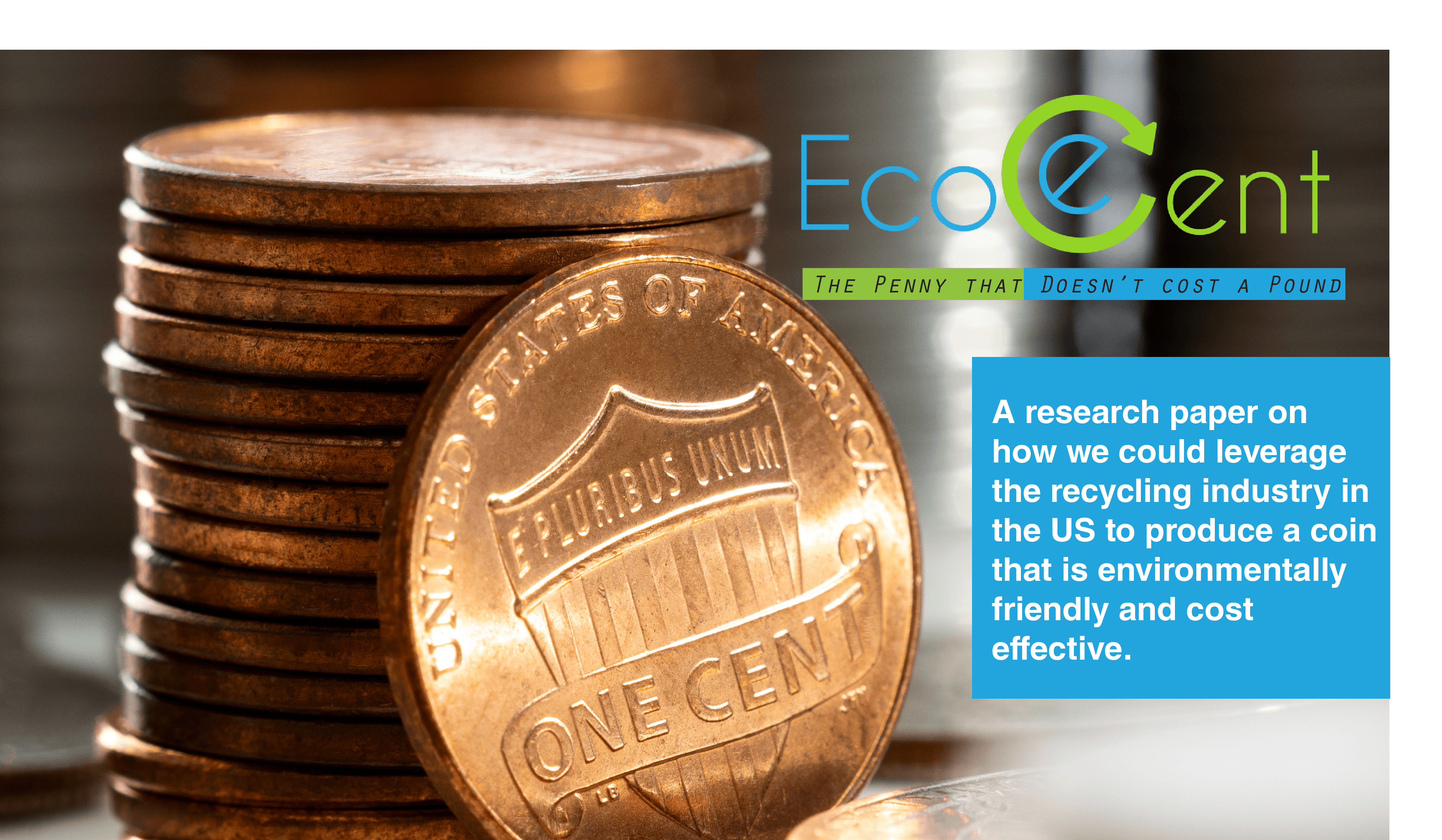
Coins from
scrap
The United States currently mints approximately 13.5 billion new coins annually. These coins are composed of alloys containing copper, zinc and nickel, resulting in the extraction of roughly 22,000 metric tons of virgin materials from domestic mines every year.
"How might we leverage the scrap recycling industry to help produce a greener, environmentally and economically sustainable coin for the US economy?"
Design Brief, EcocentThis process contributes significantly to the nation's carbon footprint. Astonishingly, it costs approximately 1.76 cents to produce a coin with a face value of just 1 cent, making it one of the most economically inefficient objects in circulation.
13.5B
Coins minted annually in the US
22K
Metric tons of virgin material extracted yearly
1.76¢
Cost to produce a 1 cent coin
$20M+
Potential annual saving via urban mining
138M MT
Recycled materials produced by US in 2018
$109B
Annual economic activity from US recycling
40%
Material cost reduction with recycled copper vs virgin
How coins are
made today
US coins are predominantly made from nickel, zinc and copper, sourced from domestic mines. The process is energy-intensive, multi-stage and entirely reliant on virgin material extraction, creating both environmental and economic inefficiency at scale.
Current US coin manufacturing process, 8 stages, entirely reliant on virgin material extraction
Cost of implementing a new coin composition, conventional vs urban mining
Conventional, change to steel
Machines to retool
22M
vending machines
Implementation cost
$10B
up to $10 billion
Annual saving
$8M – $39M
Payback period
61 – 256 years
Carbon impact
Marginal improvement
Vending compatibility
Incompatible, retool needed
Circular economy
No
vs
Ecocent, urban mining from scrap
Infrastructure retooling
Zero
same machines, same alloy
Implementation cost
$0
no capital outlay
Annual saving
$20.25M
Payback period
Year one, immediate
Carbon impact
40% material cost reduction
Vending compatibility
100% compatible, no change
Circular economy
Yes, metals stay in use
Source: US Mint feasibility studies · Sciencedirect.com material cost analysis · USGS 2022 data
Urban mining
as a solution
The US recycling industry already produces 138 million metric tons of materials annually. Of the three metals used in US coins, over 1.15 million metric tons were reclaimed from scrap in 2018 alone, over 52 times what is needed to mint the entire national coin supply.
Available scrap vs required, 2018 USGS data
Current approach
Virgin material extraction
Blast from earth, refine, melt, cast. 22,000 MT of virgin copper, zinc and nickel extracted annually. High carbon footprint. $1.76 cost per cent coin. $2.4B, $10B implementation cost for any composition change.
Ecocent approach
Urban mining from scrap
Reclaim metals already in circulation. 40% cheaper material cost. $20.25M annual saving. No retooling of existing vending machine infrastructure required. Same metals, same dimensions, same alloy ratios.
The proposed
Ecocent process
The Ecocent proposal introduces only two new steps into an otherwise unchanged manufacturing process. Scrap metal is collected from yards across the country and sorted by composition, then fed directly into step 3 of the existing US Mint process.
Steps 01 (mining) and 02 (refining virgin ore) are bypassed entirely. From step 03 onwards, the process is identical to what the Mint already does every day, using the same equipment, the same alloy ratios, the same coin dimensions and the same vending machine infrastructure.
This is not a reinvention of coin manufacturing. It is a targeted intervention at the source of the problem, replacing the most carbon-intensive and costly part of the process with a cleaner, cheaper and already-existing alternative.
What changes
2 new steps added: Collection and Sorting of scrap metals. Steps 01 (Mine) and 02 (Refine) removed from the process entirely.
What stays the same
Steps 03, 08 identical. Same alloy ratios. Same coin dimensions. Same vending machine compatibility. No capital outlay on infrastructure.
The result
$20.25M annual saving. 40% reduction in material cost. Measurable carbon footprint reduction. Immediate from year one.
Ecocent process, scrap metal collection joins at step 3
Ecocent process: only 2 additional steps, steps 01 and 02 bypassed, steps 03, 08 identical to existing mint process
The case for
urban mining
In stark contrast to the extraction-heavy status quo, the United States already produces 138 million metric tons of recycled materials per year, generating $109.78 billion in annual economic activity. The infrastructure exists. The material exists. The economic logic is clear.
One tonne of recycled copper costs approximately $3,000 compared to $5,500 for virgin copper, a 40% material cost reduction, while keeping the metal in the circular economy rather than extracting more from the earth.
Urban mining can deliver a saving of nearly $20.25M annually, without the $2.4B, $10B implementation cost associated with moving to entirely new metal compositions. The same result, at a fraction of the disruption.
$3,000
Per tonne of recycled copper
vs $5,500 for virgin copper
$20.25M
Annual saving via urban mining
13.5B coins × 15¢ avg cost reduction
1.15M MT
Scrap available per year
We need less than 2% of it
The wider impact
Improving the efficiency of coin production would enable the nation to redirect the resulting savings toward welfare measures, education and community investment, helping individuals lift themselves out of poverty and toward a more prosperous future.
Next case study
From Seaweed to Sneakers
Sargassum, Sustainable Foam Manufacturing Research