NEW CASE STUDIES THE SARGASSUM CASE STUDY

From Seaweed to Sneakers, Dave Remedios

Research Project 03 · Sustainability

From Seaweed
to Sneakers

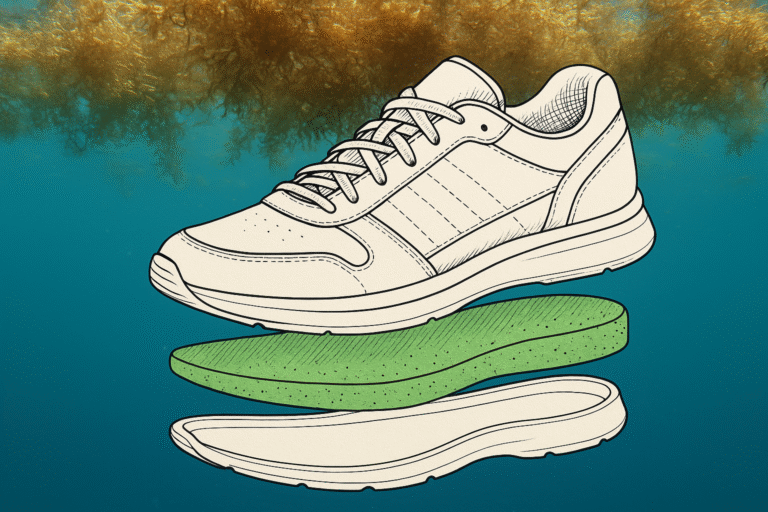
Assessing the commercial potential of Sargassum seaweed in the Caribbean as a sustainable raw material for bio-based foam in athletic footwear soles, with triple-bottom-line value for people, planet and profit.

Research Details 03

Research Question

Can Sargassum seaweed, accumulating as an environmental threat in the Caribbean, be transformed into a viable bio-based foam alternative to petrochemical EVA for athletic footwear?

Method

Chemical Analysis Prototyping Life Cycle Assessment OKALA Framework

Author

Dave Remedios

Type

Research Project · Bio-materials · Sustainability

Institution

Parsons School of Design, New York
Material

Sargassum seaweed (alginate)

Application

Athletic footwear soles

CO2 reduction

0.155 lower OKALA vs Bloom foam

Region

Caribbean · North Atlantic

From Seaweed to Sneakers
Abstract

Turning a nuisance
into a resource

This research explores the commercial potential of Sargassum seaweed as a sustainable raw material for bio-based foam in athletic footwear soles. Motivated by both the environmental threat of uncontrolled Sargassum blooms in the Caribbean and global demand for alternatives to petroleum-based materials, the study combines chemical analysis, prototyping and comparative Life Cycle Assessment.

"The findings present a scalable, eco-conscious manufacturing opportunity that supports circular economy principles and offers triple-bottom-line value, benefiting people, planet and profit."

Research summary

Sargassum-derived alginate can be processed into a lightweight, elastic foam with comparable performance to industry-standard materials. The foam shows a 0.155-point lower OKALA impact factor compared to Bloom foam, and the research proposes a proactive ocean-based harvesting strategy that improves biomass quality while mitigating coastal damage.

The Issue

Two crises.
One solution.

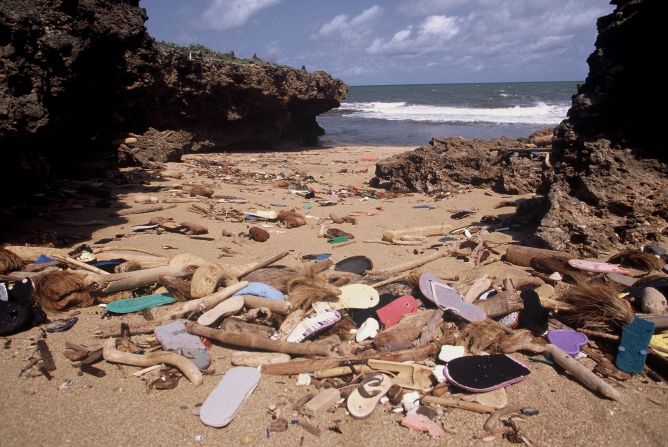
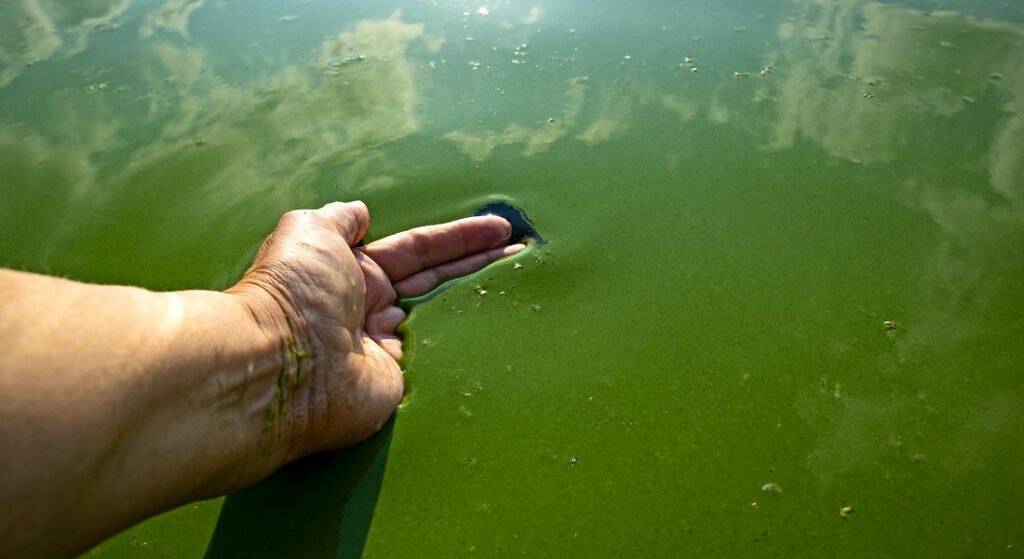
Sargassum seaweed is flooding Caribbean coastlines as an uncontrolled environmental threat. At the same time, 8 million metric tons of plastic enter the ocean every year. This research proposes using both problems as the raw material for a solution.
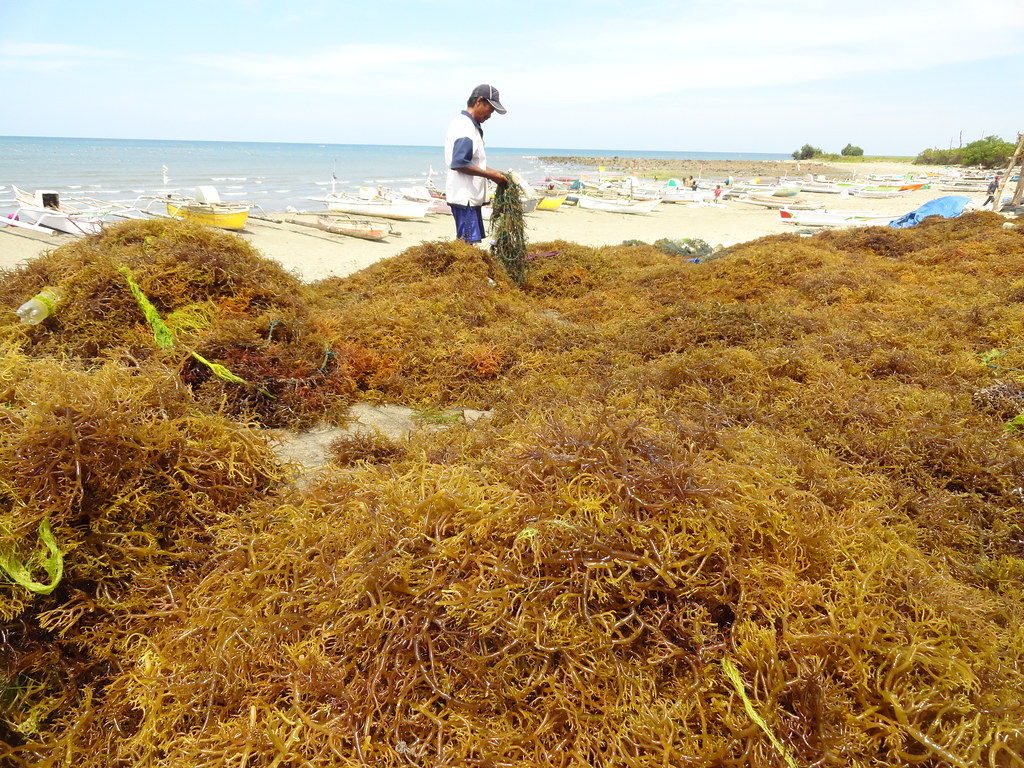
Sargassum on Caribbean beach
Sargassum accumulation on Caribbean coastline
Plastic waste on beach
Ocean plastic pollution, the second crisis this research addresses

People

Health and livelihoods

Decomposing Sargassum releases hydrogen sulphide gas, causing respiratory issues for coastal communities. The stench and visual degradation devastates fragile fishing and tourism industries that millions depend on.

Planet

Ecological damage

Uncontrolled Sargassum smothers coral reefs, depletes oxygen levels in coastal waters, releases methane as it decomposes and kills marine species at the base of the Caribbean food chain.

Profit

Economic losses

In 2022, Caribbean industry losses attributable to Sargassum reached $102 million, with cleanup costs adding a further $210 million. Local management efforts are labour-intensive, expensive and rarely sufficient.

Chemical Structure

Understanding
the material

Research began with a deep dive into the chemical composition of Sargassum, studying its molecular makeup to identify compounds with commercial potential. The most significant finding was alginate, a naturally occurring polymer that makes up approximately 40% of Sargassum's structure.

Alginate already appears in everyday products: as a thickener in ice cream, a healing agent in wound dressings and a setting compound in dental molds. In industrial applications it can produce bio-plastics, packaging materials, polyesters and foams, all sustainable alternatives to petrochemical products.

This research was inspired by Bloom Foam, which manufactures high-performance foam using blue-green algae, already deployed by Nike and Adidas. The question became: could Sargassum, washing up in massive quantities on Caribbean coastlines, be transformed into a similar material?
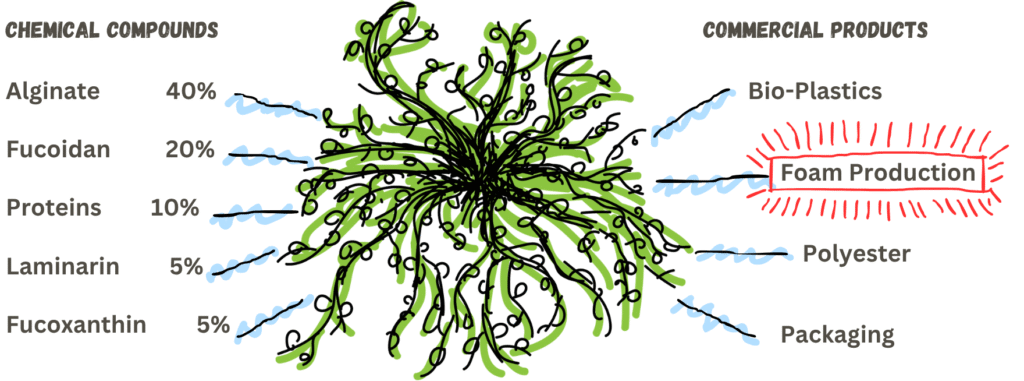
"Alginate makes up approximately 40% of Sargassum's structure, a naturally occurring polymer with proven industrial applications already used at commercial scale."

Chemical analysis findings

This research focuses on the development of bio-based foam specifically for use in the soles of technical sports footwear. Inspired by Bloom Foam, which manufactures high-performance foam using blue-green algae already deployed by Nike and Adidas, the question became: could Sargassum, washing up in massive quantities on Caribbean coastlines, be transformed into a similar material?

Chemical structure of Sargassum
Chemical composition analysis of Sargassum seaweed

Sargassum key components

Alginate

Primary bio-foam candidate. Naturally occurring polymer, proven in commercial applications including bio-plastics, packaging and foam manufacture.

40%

Fucoidan

Bioactive sulfated polysaccharide with anti-inflammatory and anti-coagulant properties. Valuable in pharmaceutical and nutraceutical applications.

20%

Mannitol

Natural sugar alcohol acting as a stabilising agent. Used in food, pharmaceutical and medical-grade applications as a safe, biodegradable additive.

15%

Minerals and proteins

Iodine, iron, calcium and structural proteins. Contribute to the material's overall bio-composite properties and potential nutritional applications.

25%

Source: Popuri, S. (UWI) · Chemical composition analysis of Sargassum spp.

Bloom Foam Reference Model

Proving bio-foam
works at scale

Before developing the Sargassum-based formula, the manufacturing process of Bloom Foam was studied as a reference model, including the materials, equipment and process steps required to produce a high-performance bio-based foam already deployed by Nike and Adidas.

Bloom Foam composition

EVA Polymer

48%

Provides cushioning, flexibility and durability

Algae Biomass

48%

Reduces environmental footprint, improves sustainability

Blowing Agents

1%

Expands the EVA into a foam structure

Inks and Additives

1%

Colour, UV resistance, texture modification
Bloom Foam
Bloom Foam, bio-based foam already deployed by Nike and Adidas

Bloom Foam manufacturing process, 10 complete steps

01

Source algae biomass

Blue-green algae (Cyanobacteria) cultivated in freshwater lakes, ponds or controlled algae farms. Quality and consistency controlled from day one.

02

Mechanical compression

Freshly harvested wet algae is mechanically pressed to remove the bulk of surface moisture before thermal treatment begins.

03

Thermal drying

Compressed algae cake undergoes high-temperature drying to eliminate all remaining moisture. The result is a dry, stable biomass residue ready for processing.

04

Grinding to fine powder

The dried biomass is ground into a uniform fine powder, maximising surface area for optimal blending with the polymer matrix in subsequent steps.

05

Blend with EVA elastomer

Key ratio

The algae powder is combined with elastomeric EVA (ethylene-vinyl acetate) in a 48:48 ratio by weight. A small percentage of blowing agent and pigment additives are introduced at this stage.

06

Compounding and pelletisation

The blended mixture is processed through a compounding extruder under heat and pressure, forming a homogenous bio-polymer compound that is then extruded into standardised pellets for consistent downstream processing.

07

Injection moulding

Pellets are fed into an injection moulding machine. The blowing agent activates under pressure and heat, expanding the compound into the foam structure and filling the mould cavity completely.

08

Curing and de-moulding

Moulded foam cures under controlled temperature and pressure conditions to set the cellular structure. Cooling is precisely managed to prevent deformation or surface defects.

09

Trimming and finishing

De-moulded soles are trimmed to final specification, removing flash and excess material. Surface treatments are applied where required for texture, grip or UV resistance.

10

Quality and performance testing

Final QC

Every batch undergoes rigorous testing: density measurement, compression set, tensile strength, elongation at break, rebound resilience and durability under simulated running loads. Must match or exceed petrochemical EVA performance benchmarks before approval.

Process Flows

The Sargassum
process

This is the centrepiece of the research. A complete 12-step, 3-phase manufacturing process that transforms an environmental problem into a commercial bio-material, without purpose-grown feedstock, without petroleum inputs, and without disrupting existing footwear manufacturing infrastructure.

Unlike Bloom Foam, which cultivates algae in controlled freshwater farms, the Sargassum process begins with a waste stream. Every kilogram of material processed represents seaweed that would otherwise decompose on a Caribbean beach, releasing methane and destroying marine ecosystems.

3 phases

Harvest, Processing, Formulation and Mould, mirroring established industrial bio-foam manufacturing with one key difference: the feedstock is waste.

12 steps

From proactive ocean harvesting through alginate extraction, compounding and injection moulding to final quality certification, a fully documented, replicable process.

The result

A bio-based foam with 0.155 lower OKALA impact than Bloom, sourced entirely from an existing environmental problem, with no dedicated cultivation required.

Sargassum bio-foam manufacturing process, 12 steps, 3 phases

PHASE 1, HARVEST PHASE 2, PROCESSING PHASE 3, FORMULATION AND MOULD 01, Collection Proactive ocean-based harvesting before beaching. Higher quality biomass. Caribbean coastlines 02, Sorting and Cleaning Marine debris, sand and contaminants removed. Grade by alginate content. Quality screening 03, Pre-treatment Wash Freshwater rinse to remove salt, heavy metals and surface toxins. pH balance. NaOH pre-soak 04, Mechanical Pressing Industrial press removes 70–80% of surface water. Reduces mass for drying. Energy efficiency step 05, Thermal Drying Rotary drum dryer at 60–80°C. Eliminate all moisture. Target <10% moisture content. Stabilises biomass 06, Grinding Hammer mill grinds dried biomass to fine powder (<100 micron). Maximise surface area for alginate extraction PHASE 3, FORMULATION, BLENDING AND MOULD 07, Alginate Extraction Sodium carbonate solution dissolves alginate. Filter and purify. ~40% yield Key active ingredient 08, Blend with EVA Alginate + EVA elastomer + baking powder + cornstarch + natural rubber. 5-component formula 09, Compounding Twin-screw extruder processes blend under heat and pressure. Extruded to pellets. Homogeneous compound 10, Injection Moulding Pellets fed into mould. Blowing agent activates under 160–180°C heat. Foam expands to fill sole cavity. Sole shape formed 11, Cure and De-mould Controlled cooling sets cell structure. De-mould at <40°C. Check for voids and surface defects. Structural integrity 12, QC and Finish Trim flash. Surface treatment for grip. Density, rebound, compression, tensile strength all tested. Ready for footwear

Key advantages over Bloom Foam

Biomass is waste, not farmed

No dedicated cultivation required

0.155 lower OKALA impact factor

Supports Caribbean livelihoods

Reduces coastal environmental damage

Fully biodegradable polymer matrix

Life Cycle Assessment

The environmental
case, validated

A comparative Life Cycle Assessment (LCA) was conducted using the OKALA impact assessment framework across four production phases: raw material, processing, manufacturing and end of life. The analysis covered three materials side by side: 100% petrochemical EVA, Bloom Foam and the proposed Sargassum bio-foam. The average pair of sneakers contains approximately 0.3 lbs (136g) of foam per sole.

OKALA LIFE CYCLE ASSESSMENT, COMPARATIVE ENVIRONMENTAL IMPACT ANALYSIS 100% Petrochemical EVA 0.484 lbs CO2 Entirely petroleum-derived · No bio content · Highest environmental impact Bloom Foam (48% blue-green algae) 0.382 lbs CO2 Cultivated freshwater algae · 0.102 lbs better than EVA · Current market leader Sargassum Bio-Foam (proposed) 0.227 lbs CO2 Waste-stream feedstock · 0.155 lower than Bloom · Best-in-class environmental performance 40.6% lower than Bloom 53.1% lower than EVA 0 lbs CO2 0.25 lbs CO2 0.5 lbs CO2 OKALA IMPACT FACTOR BREAKDOWN BY PRODUCTION PHASE Raw Material Processing Manufacturing End of Life Total EVA (petrochemical) 0.221 0.142 0.098 0.023 0.484 Bloom Foam 0.155 0.128 0.078 0.021 0.382 Sargassum Foam 0.062 0.112 0.038 0.015 0.227 OKALA Impact Assessment Framework · Remedios, D. (2025) · Parsons School of Design · Data per 0.3 lbs (136g) foam, one pair of footwear soles

100% Petrochemical EVA

0.484

lbs CO2 per pair of soles

Highest raw material impact: 0.221

Entirely petroleum-derived

No biodegradable component

Non-renewable feedstock

Bloom Foam (48% algae)

0.382

lbs CO2 per pair of soles

0.102 lbs better than EVA

Farmed freshwater algae

Used by Nike and Adidas

Current bio-foam benchmark

Sargassum Foam (proposed)

0.227

lbs CO2 per pair of soles

0.155 lower than Bloom

53.1% lower than virgin EVA

Waste-stream feedstock

Best-in-class LCA result

Scale impact projection, if adopted at 10% of Nike annual production

780M

pairs produced by Nike annually

78M

pairs at 10% adoption rate

12.1M lbs

CO2 reduction vs EVA

5,490 MT

metric tons CO2 saved per year

Equivalent to removing approximately 1,190 passenger cars from the road for one year. Source: EPA vehicle emissions calculator.

Prototype validation

Controlled lab experiments confirmed that sodium alginate dissolved in water and set in calcium carbonate bath produces a translucent, lightweight, flexible foam with tactile properties comparable to Nike Air sole material. Lightweight, slightly squishy, elastic, flexible.

OKALA methodology

The OKALA framework is a widely validated LCA tool used across product design and materials science. It assigns environmental impact scores per unit mass across raw material, processing, manufacturing and end-of-life phases, enabling like-for-like comparison across material types.

Prototyping

From seaweed
to sole

A series of controlled experiments were conducted to explore how foam could be manufactured using Sargassum. The process involved dissolving sodium alginate in water, heating gently, adding to a calcium carbonate bath to gel and pouring into a mold. The result: a translucent, lightweight, slightly flexible foam comparable in feel to the foam used in Nike Air soles.
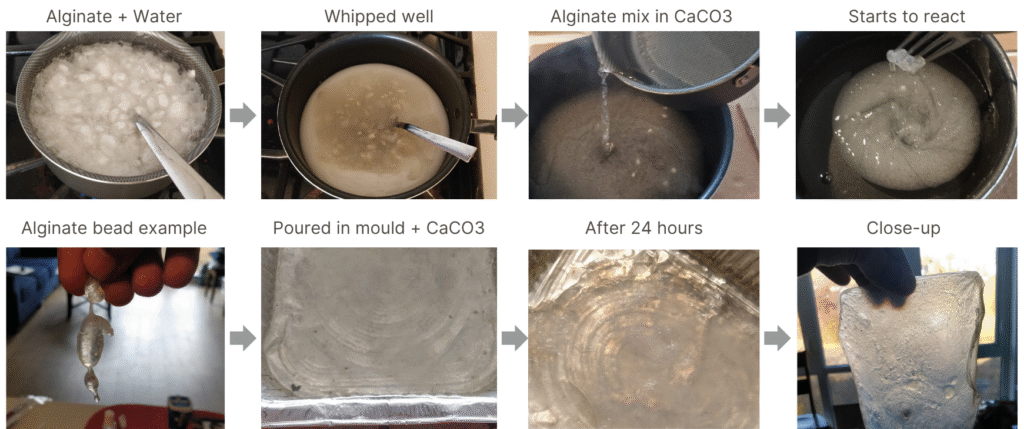
Sargassum foam prototype
Sargassum foam prototype, lightweight, translucent, flexible
Conclusion

Sargassum is not a problem. It is an untapped material waiting for the right process.

This research demonstrates a clear pathway from an environmental burden to a commercial resource, with measurable reductions in CO2 emissions, potential to support Caribbean livelihoods through ocean-based harvesting and a bio-foam performance that rivals existing market leaders. The material is there. The science works. The commercial case is compelling.

0.155

Lower OKALA vs Bloom

40%

Alginate content in Sargassum

$312M

Caribbean annual Sargassum impact

Coming soon

Case Study 04

A new research project, coming shortly

Back to research
Scroll to Top