Research Project 03 · Sustainability
From Seaweed
to Sneakers
Assessing the commercial potential of Sargassum seaweed in the Caribbean as a sustainable raw material for bio-based foam in athletic footwear soles, with triple-bottom-line value for people, planet and profit.
Research Question
Can Sargassum seaweed, accumulating as an environmental threat in the Caribbean, be transformed into a viable bio-based foam alternative to petrochemical EVA for athletic footwear?
Method
Author
Dave Remedios
Type
Research Project · Bio-materials · Sustainability
Institution
Parsons School of Design, New York
Two crises.
One solution.
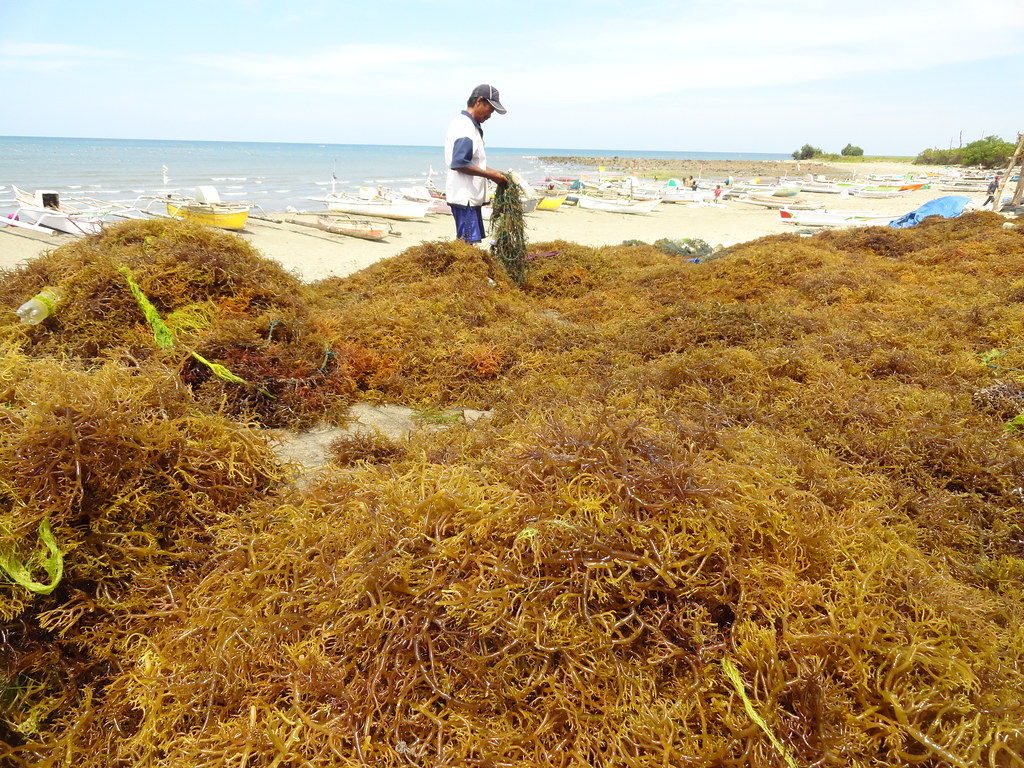
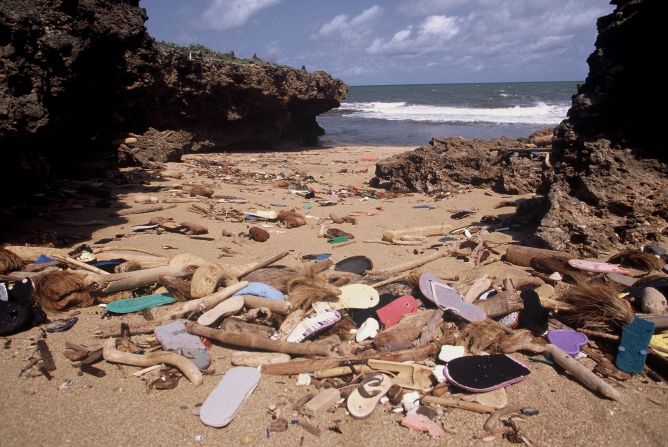
Sargassum seaweed is flooding Caribbean coastlines as an uncontrolled environmental threat. At the same time, 8 million metric tons of plastic enter the ocean every year. This research proposes using both problems as the raw material for a solution.
People
Health and livelihoods
Decomposing Sargassum releases hydrogen sulphide gas, causing respiratory issues for coastal communities. The stench and visual degradation devastates fragile fishing and tourism industries that millions depend on.
Planet
Ecological damage
Uncontrolled Sargassum smothers coral reefs, depletes oxygen levels in coastal waters, releases methane as it decomposes and kills marine species at the base of the Caribbean food chain.
Profit
Economic losses
In 2022, Caribbean industry losses attributable to Sargassum reached $102 million, with cleanup costs adding a further $210 million. Local management efforts are labour-intensive, expensive and rarely sufficient.
Understanding
the material
Research began with a deep dive into the chemical composition of Sargassum, studying its molecular makeup to identify compounds with commercial potential. The most significant finding was alginate, a naturally occurring polymer that makes up approximately 40% of Sargassum's structure.
Alginate already appears in everyday products: as a thickener in ice cream, a healing agent in wound dressings and a setting compound in dental molds. In industrial applications it can produce bio-plastics, packaging materials, polyesters and foams, all sustainable alternatives to petrochemical products.
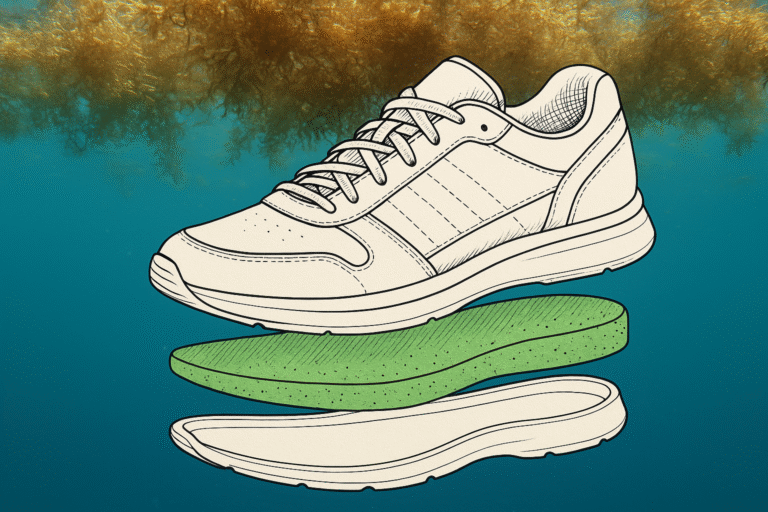
This research was inspired by Bloom Foam, which manufactures high-performance foam using blue-green algae, already deployed by Nike and Adidas. The question became: could Sargassum, washing up in massive quantities on Caribbean coastlines, be transformed into a similar material?
"Alginate makes up approximately 40% of Sargassum's structure, a naturally occurring polymer with proven industrial applications already used at commercial scale."
Chemical analysis findingsThis research focuses on the development of bio-based foam specifically for use in the soles of technical sports footwear. Inspired by Bloom Foam, which manufactures high-performance foam using blue-green algae already deployed by Nike and Adidas, the question became: could Sargassum, washing up in massive quantities on Caribbean coastlines, be transformed into a similar material?
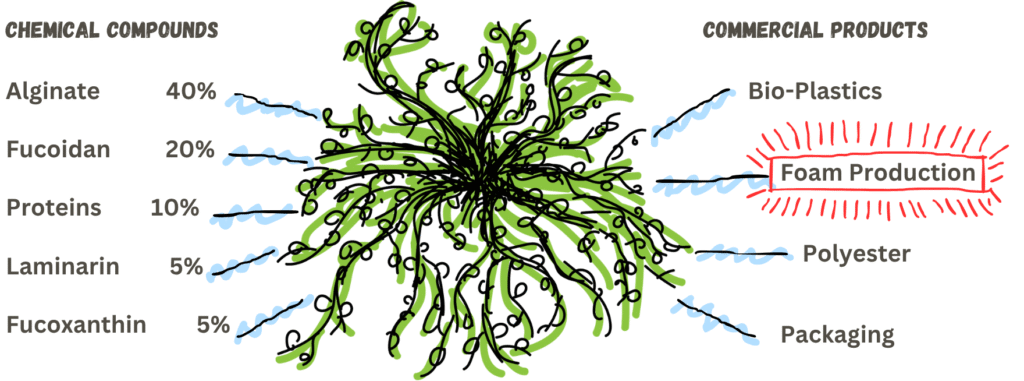
Sargassum key components
Alginate
Primary bio-foam candidate. Naturally occurring polymer, proven in commercial applications including bio-plastics, packaging and foam manufacture.
40%
Fucoidan
Bioactive sulfated polysaccharide with anti-inflammatory and anti-coagulant properties. Valuable in pharmaceutical and nutraceutical applications.
20%
Mannitol
Natural sugar alcohol acting as a stabilising agent. Used in food, pharmaceutical and medical-grade applications as a safe, biodegradable additive.
15%
Minerals and proteins
Iodine, iron, calcium and structural proteins. Contribute to the material's overall bio-composite properties and potential nutritional applications.
25%
Source: Popuri, S. (UWI) · Chemical composition analysis of Sargassum spp.
Proving bio-foam
works at scale
Before developing the Sargassum-based formula, the manufacturing process of Bloom Foam was studied as a reference model, including the materials, equipment and process steps required to produce a high-performance bio-based foam already deployed by Nike and Adidas.
Bloom Foam composition
EVA Polymer
48%
Provides cushioning, flexibility and durability
Algae Biomass
48%
Reduces environmental footprint, improves sustainability
Blowing Agents
1%
Expands the EVA into a foam structure
Inks and Additives
1%
Colour, UV resistance, texture modification
Bloom Foam manufacturing process, 10 complete steps
01
Source algae biomass
Blue-green algae (Cyanobacteria) cultivated in freshwater lakes, ponds or controlled algae farms. Quality and consistency controlled from day one.
02
Mechanical compression
Freshly harvested wet algae is mechanically pressed to remove the bulk of surface moisture before thermal treatment begins.
03
Thermal drying
Compressed algae cake undergoes high-temperature drying to eliminate all remaining moisture. The result is a dry, stable biomass residue ready for processing.
04
Grinding to fine powder
The dried biomass is ground into a uniform fine powder, maximising surface area for optimal blending with the polymer matrix in subsequent steps.
05
Blend with EVA elastomer
Key ratioThe algae powder is combined with elastomeric EVA (ethylene-vinyl acetate) in a 48:48 ratio by weight. A small percentage of blowing agent and pigment additives are introduced at this stage.
06
Compounding and pelletisation
The blended mixture is processed through a compounding extruder under heat and pressure, forming a homogenous bio-polymer compound that is then extruded into standardised pellets for consistent downstream processing.
07
Injection moulding
Pellets are fed into an injection moulding machine. The blowing agent activates under pressure and heat, expanding the compound into the foam structure and filling the mould cavity completely.
08
Curing and de-moulding
Moulded foam cures under controlled temperature and pressure conditions to set the cellular structure. Cooling is precisely managed to prevent deformation or surface defects.
09
Trimming and finishing
De-moulded soles are trimmed to final specification, removing flash and excess material. Surface treatments are applied where required for texture, grip or UV resistance.
10
Quality and performance testing
Final QCEvery batch undergoes rigorous testing: density measurement, compression set, tensile strength, elongation at break, rebound resilience and durability under simulated running loads. Must match or exceed petrochemical EVA performance benchmarks before approval.
From seaweed
to sole
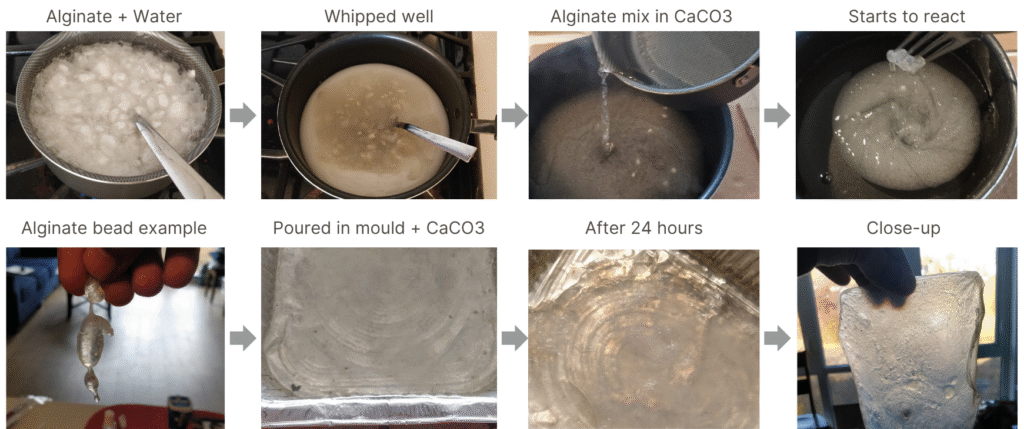
A series of controlled experiments were conducted to explore how foam could be manufactured using Sargassum. The process involved dissolving sodium alginate in water, heating gently, adding to a calcium carbonate bath to gel and pouring into a mold. The result: a translucent, lightweight, slightly flexible foam comparable in feel to the foam used in Nike Air soles.